

TreeMap
Overview
Section titled “Overview”- Type: One-dimensional area-based hierarchical chart
- Dimensions: Proportional rectangles sized by measure value
- Use cases: Show hierarchical data, display multi-level breakdowns, visualize large datasets with drill-down, compare proportions across categories
- Special features: Supports multi-level drill-down, area size represents percentage of total (50% of total = 50% of area)
- Visual: Nested rectangles where size represents value, enabling visual comparison of proportions
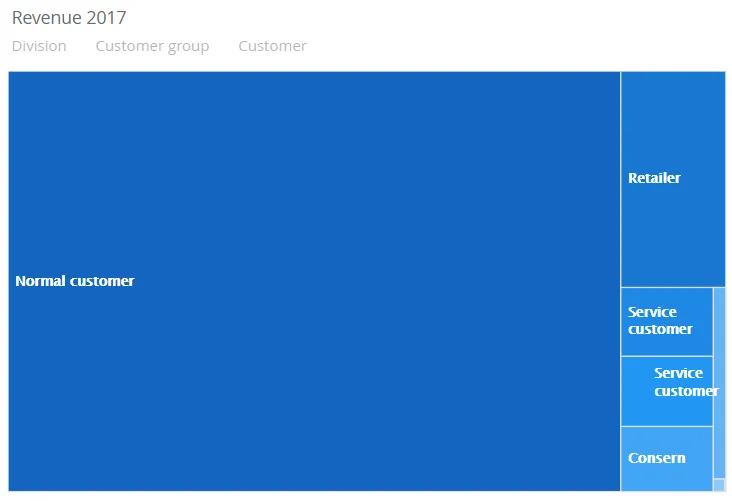
The image shows a treemap displaying revenue by division, customer group, and customer number, with rectangle sizes proportional to revenue amounts.
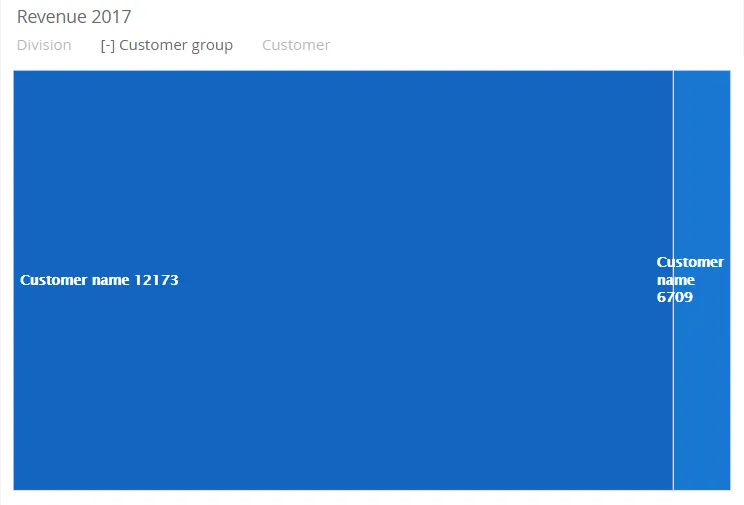
The second image shows the same treemap with multi-level filtering enabled, allowing users to drill down from division to customer group to customer number.
Quickstart
Section titled “Quickstart”To create a TreeMap, initialize the graph with hierarchical split element, add an axis, and use addGraphData with chart_type: "treemap".
$olap.addGraph("2","Revenue ?period.getYear()","[division]:[customer_group]:[customer_number]","[invoice_year]=?period.getYear()","0");$olap.addGraphAxis("2","1","Amount","");$olap.addGraphData("2","1","Revenue","[division]:[customer_group]:[customer_number]","sum([invoiced_amount_dcur])","treemap","","","","M");This produces a treemap where rectangle sizes represent revenue, with drill-down capability from division → customer group → customer number.
Series setup
Section titled “Series setup”TreeMaps use hierarchical series columns separated by colons. The hierarchy must match in both addGraph and addGraphData.
Required setup:
$olap.addGraph("graph_id", "Title", "[level1]:[level2]:[level3]", "filter","0");$olap.addGraphAxis("graph_id","axis_id","Label","");$olap.addGraphData("graph_id","axis_id","Label", "[level1]:[level2]:[level3]", "measure", "treemap","","","","M");Key points:
- Use colon
:to separate hierarchy levels:"[division]:[customer_group]" - Same hierarchy must appear in both
addGraphsplit element andaddGraphDataseries - Each level enables drill-down filtering
- Order matters: first level = top level, last level = most detailed
Example - Two levels:
$olap.addGraph("1", "Sales by Region", "[region]:[country]", "","0");$olap.addGraphData("1","1","Sales", "[region]:[country]", "sum([sales])", "treemap","","","","M");Example - Three levels:
$olap.addGraph("1", "Revenue Breakdown", "[division]:[product_group]:[product]", "","0");$olap.addGraphData("1","1","Revenue", "[division]:[product_group]:[product]", "sum([revenue])", "treemap","","","","M");Data series
Section titled “Data series”Add data using addGraphData with chart_type: "treemap". The series column defines the hierarchy.
Syntax:
$olap.addGraphData( "graph_id", "axis_id", "dataseries_label", "series", // Hierarchical: "[level1]:[level2]:[level3]" "measure", "treemap", "", "filter", "limit", "orderby")Parameters:
| Parameter | Required | Description | Example |
|---|---|---|---|
graph_id | Yes | Unique graph identifier | "2" |
axis_id | Yes | The axis ID | "1" |
dataseries_label | Yes | Label for the series | "Revenue" |
series | Yes | Hierarchical columns separated by : | "[division]:[customer_group]" |
measure | Yes | Value determining rectangle size | "sum([amount])" |
chart_type | Yes | Must be "treemap" | "treemap" |
aggregation | No | Not used (use "") | "" |
filter | No | Additional filter | "[year] = 2024" |
limit | No | Limit items shown | "20" |
orderby | No | Sort method. "M" for largest first | "M" |
Example - Single level:
$olap.addGraph("1", "Sales by Product", "[product]", "","0");$olap.addGraphData("1","1","Sales", "[product]", "sum([sales])", "treemap","","","","M");Example - Multi-level with filter:
$olap.addGraph("2","Revenue","[division]:[customer_group]:[customer_number]","[invoice_year]=?period.getYear()","0");$olap.addGraphData("2","1","Revenue","[division]:[customer_group]:[customer_number]","sum([invoiced_amount_dcur])","treemap","","","","M");Size and layout
Section titled “Size and layout”Control responsive width using setGraphSize. TreeMaps benefit from larger sizes to show detail.
$olap.setGraphSize("graph_id", "XS12", "SM6", "MD6", "LG6")Recommended sizes:
- Medium:
"XS12", "SM6", "MD6", "LG6"(half width) - Large:
"XS12", "SM8", "MD8", "LG8"(two-thirds width) - Full:
"XS12", "SM12", "MD12", "LG12"(full width)
Common patterns
Section titled “Common patterns”Single level treemap
Section titled “Single level treemap”Simple proportional comparison:
$olap.addGraph("1", "Sales by Region", "[region]", "","0");$olap.addGraphAxis("1","1","Amount","");$olap.addGraphData("1","1","Sales", "[region]", "sum([sales])", "treemap","","","","M");Multi-level drill-down
Section titled “Multi-level drill-down”Enable hierarchical exploration:
$olap.addGraph("1", "Revenue Hierarchy", "[division]:[department]:[product]", "","0");$olap.addGraphData("1","1","Revenue", "[division]:[department]:[product]", "sum([revenue])", "treemap","","","","M");Filtered treemap
Section titled “Filtered treemap”Focus on specific subset:
$olap.addGraph("1", "Q4 Sales", "[category]:[subcategory]", "[quarter] = 4 AND [year] = 2024","0");$olap.addGraphData("1","1","Sales", "[category]:[subcategory]", "sum([sales])", "treemap","","","","M");Top N items
Section titled “Top N items”Show only largest categories:
$olap.addGraphData("1","1","Revenue", "[product]", "sum([revenue])", "treemap","","","10","M");Time-based treemap
Section titled “Time-based treemap”Show breakdown for specific period:
$olap.addGraph("1", "2024 Revenue", "[category]:[item]", "[year] = 2024","0");$olap.addGraphData("1","1","Revenue", "[category]:[item]", "sum([revenue])", "treemap","","","","M");Troubleshooting
Section titled “Troubleshooting”Treemap not showing
Section titled “Treemap not showing”- Check: Ensure
chart_typeis exactly"treemap"(lowercase) - Check: Verify hierarchy matches in both
addGraphandaddGraphData - Check: Ensure measure returns numeric values
- Check: TreeMap can only be built on the report’s main data source (not alternative sources)
Drill-down not working
Section titled “Drill-down not working”- Issue: Clicking doesn’t show next level
- Fix: Hierarchy in
addGraphsplit element must matchaddGraphDataseries exactly - Fix: Both must use same column order:
"[level1]:[level2]"in both places - Fix: Ensure data exists for drill-down levels
NULL value errors
Section titled “NULL value errors”- Issue: Chart fails or shows incorrectly
- Fix: TreeMaps are sensitive to NULL values. Always exclude them:
$olap.addGraph("1", "Title", "[level1]:[level2]", "[level1] IS NOT NULL AND [level2] IS NOT NULL","0");
Rectangles too small
Section titled “Rectangles too small”- Issue: Many small rectangles hard to see
- Fix: Use
limitto show only top N items:$olap.addGraphData("1","1","Revenue", "[item]", "sum([amount])", "treemap","","","20","M"); - Fix: Filter to relevant subset before charting
Wrong proportions
Section titled “Wrong proportions”- Issue: Rectangle sizes don’t match expected values
- Check: Verify measure calculation (use sum, not avg for totals)
- Check: Ensure filter doesn’t exclude part of hierarchy
- Check: NULL values may affect calculations
Q: Can I use setGraphSource with treemaps?
A: No, treemaps can only use the report’s main data source. Alternative sources are not supported.
Q: How many levels can I have?
A: Typically 2-4 levels work well. More levels can make the treemap cluttered and hard to navigate.
Q: What’s the difference between treemap and pie charts?
A: Treemaps show hierarchical data with drill-down. Pies show flat proportional breakdowns. Use treemap for multi-level data, pie for single-level.
Q: Can I sort the rectangles?
A: Yes, use orderby: "M" to sort by measure (largest first). This helps show most important items prominently.
Q: How do I limit which items appear?
A: Use the limit parameter in addGraphData to show only top N items, or filter in addGraph to focus on specific subset.
Q: Why do I get errors with NULL values?
A: TreeMaps are sensitive to NULLs. Always filter them out: "[column] IS NOT NULL" in your filter expression.
Q: Can I have multiple treemap series?
A: No, treemaps work with a single series. For multiple breakdowns, create separate graphs.
Q: How do I ensure drill-down works?
A: The hierarchy in addGraph split element must exactly match the hierarchy in addGraphData series. Both must use the same columns in the same order.
Related
Section titled “Related”- Graph Method Overview - Complete reference for all graph methods
- Pie - Alternative proportional visualization (single level)
- Column - Stacked columns as alternative
- addGraphData - Method documentation